Functioning and Disability
The package “health_disability” combines the person’s biological/medical domain with the personal and environmental (exposome) contexts to assess the functionality level at individual and population level. It is a key package because it provides a holistic approach to the person (and patient), well beyond the traditional “system of disease”.
The package integrates the International Classification of Functionality, Disability and Health (ICF) from the World Health Organization, and works very well with the current ICD-11 and health_socioeconomics package, both available in GNU Health.
Introduction to ICF
The World Health Organization created the International Classification of Functionality, Disability and Health - ICF - to move beyond the mere classification of diseases and causes of death, as in the case of ICD. While the International Classification of Diseases (specially those prior and including ICD-10), the ICF classifies the health of people in a much broader context. To put an example, two people with the same diagnosis of Type 1 diabetes can have different health status. In short, ICF combines the biological and social models of disability.
In the context of Social Medicine and Public Health, ICF is a great “eye-opener”. It provides very valuable information about an individual disability and their needs to overcome it and to improve the quality of life. At population level, ICF becomes a great ally in epidemiology and health statistics. With good population disability reports, funds can be movilized to focused, effective health promotion and disease prevention campaigns. Properly used, ICF can create a more equitable society and improve the functionality level of the indivual and population.
The World Health organization defines the following terms related to Functioning and Disability as follows:
Functioning: It denotes the positive aspects of the interaction between an individual (with a health condition).
Disability: An umbrella for the impairments, activity limitations and participation restrictions. It denotes the negative aspects of the interaction between an individual (with a health condition) and that individual’s contextual factors (environmental and personal factors)
Activity: The execution of a task or action by an individual.
Participation: Involvement in a life situation.
Impairments: Problems in body function and structure such as significant deviation or loss
Capacity: What a person with a health contidion can do in a standard environment
Performance: What a person with a health condition can do in their own, modified environment (e.g., after adapting the shower or the bus seats).
The ICF model
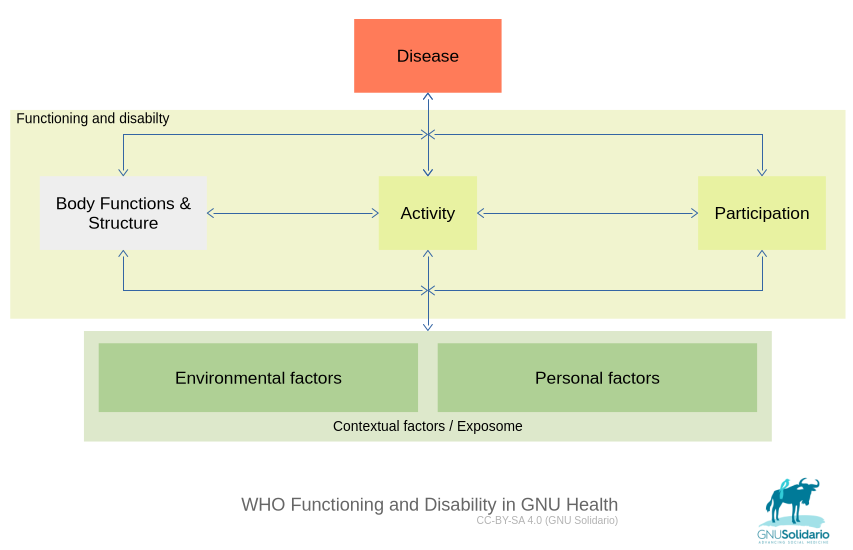
The ICF model is composed of parts, components, domains and qualifiers
Parts : The ICF is organized in two parts: * Functioning and Disability * Contextual Factors
The parts are subvidived into components. * Functioning and Disability part * Body Functions and Body Structures component * Activities and Participation component
Contextual factors part
Environmental factors component
Personal Factors component
Components themselves are divided into domains, which have a number of categories (the classification unit). Finally, the qualifiers provide the extent of functioning or disability in that particular category.
Assessing a person’s functioning and disability status with GNU Health
The person’s degree of functioning (or disability) is not determined by just a disease. It is the result of a complex interaction of the bio-psycho-social-spiritual spheres throught their life.
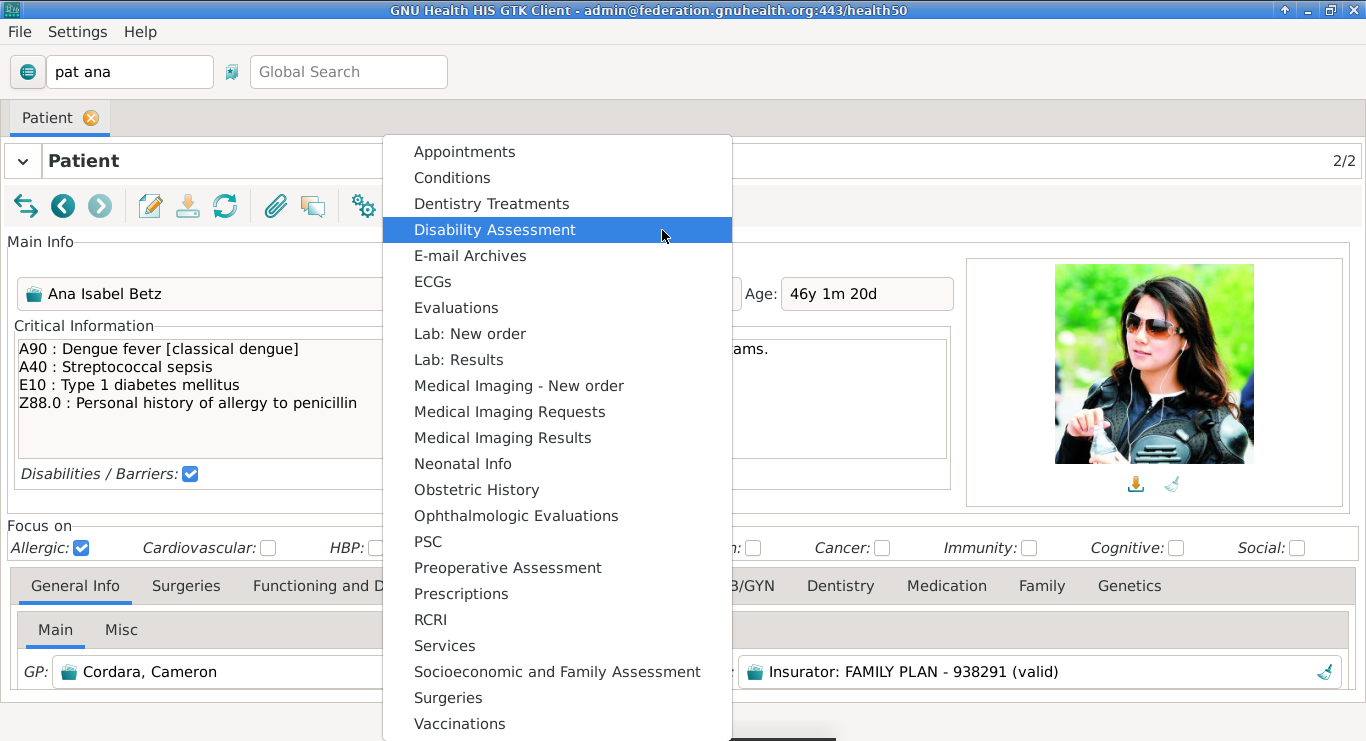
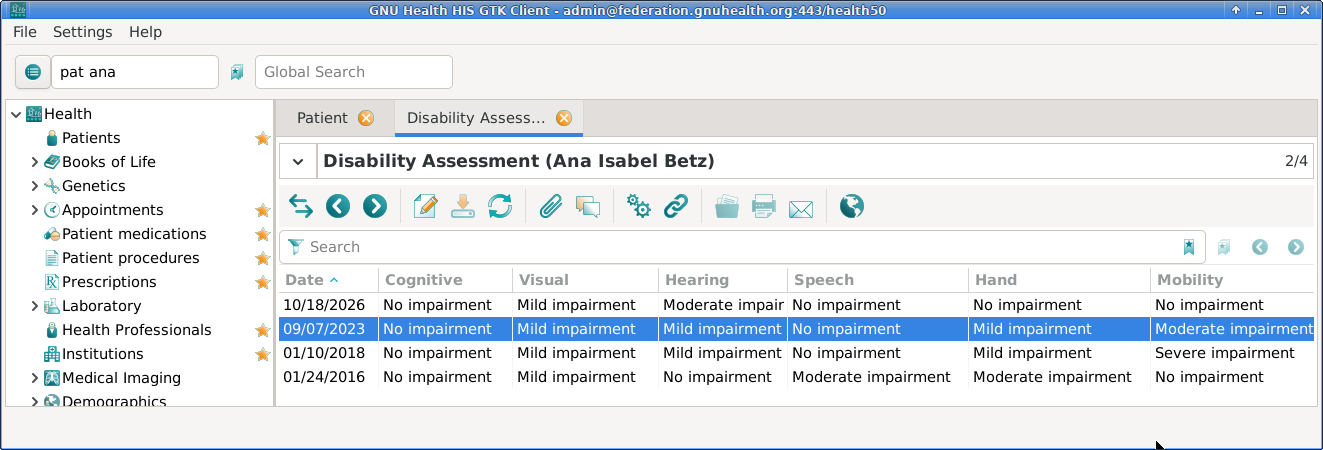
When you access the “Disability Assessment” of the patient, a list view shows all the evaluations done in this context to a patient.
In GNU Health, and similar to the socioeconomic and family functionality evaluations, the functioning and disability assessments are not reduced to a single snapshot, but they become a longitudinal, lifelong process on the individual.
The assessment will be saved and stored in the patient history.
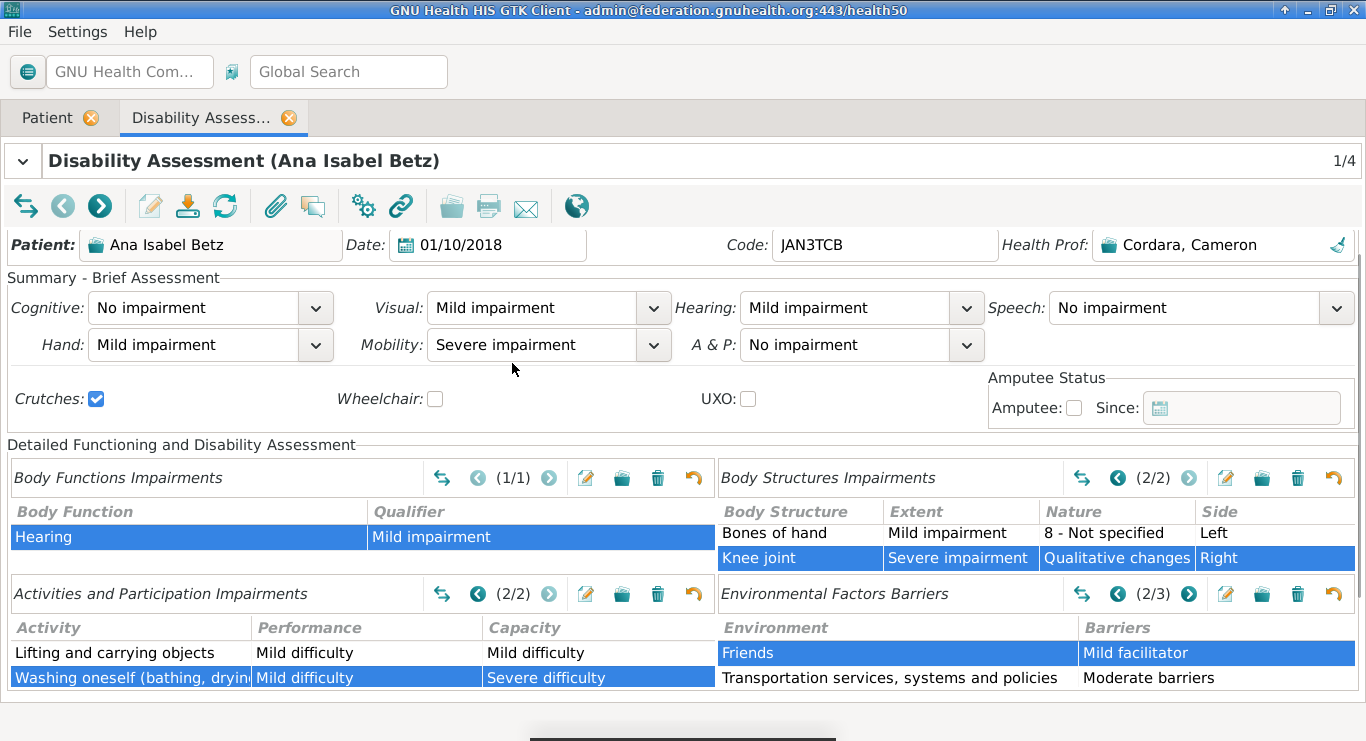
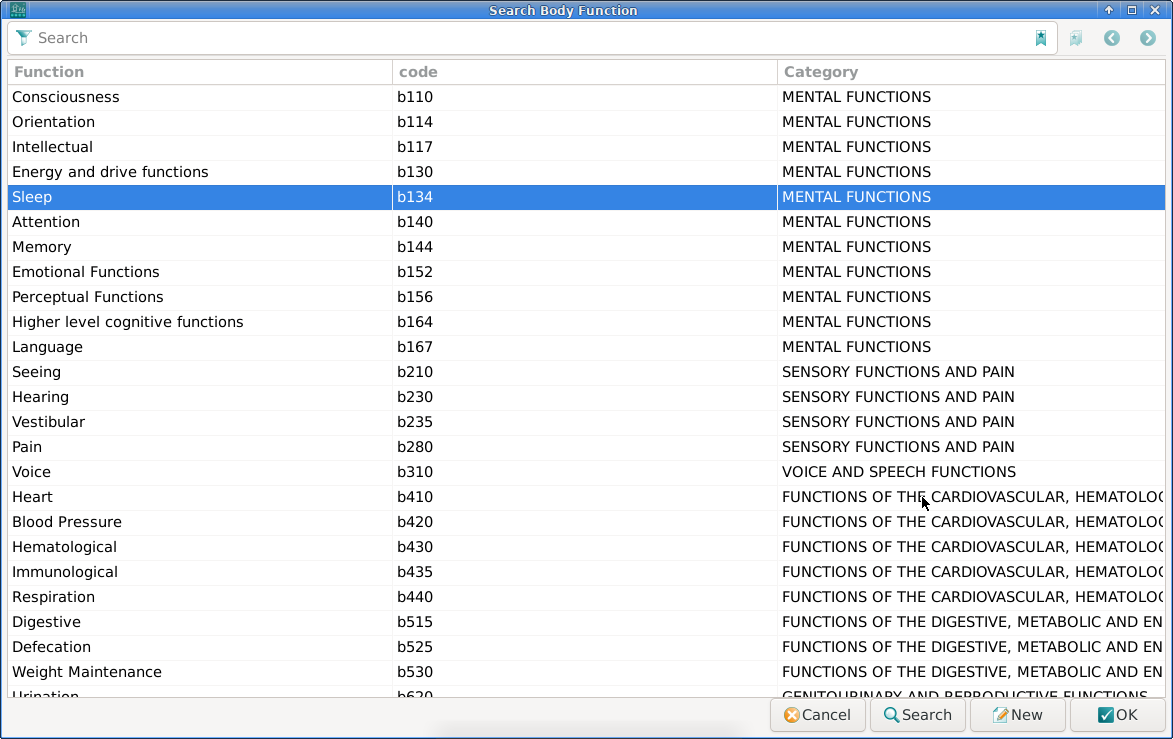
Body Functions
Mental Functions
Sensory Functions and Pain
Voice and Speech Functions
Functions of the Cardiovascular, Haematological, Immunological and Respiratory Systems
Functions of the Digestive, Metabolic, Endocrine, Systems
Genitourinary and Reproductive Functions
Neuromusculoskeletal and Movement-Related Functions
Functions af the Skin and Related Structures
Body functions Impairments: The qualifier for the Body function impairments are: * [No, mild, severe, complete] impairment * Not specified // Not aplicable
Body Structure
The Body Structure domain list has three impairment groups: Extent, Nature and Side
Extent qualifiers * [No, mild, severe, complete] impairment * Not specified * Not aplicable
Nature qualifiers: * No change in structure * Total absence * Partial absence * Additional part * Aberrant dimensions * Discontinuity * Deviating position * Qualitative changes in structure, including accumulation of fluid * Not specified * Not applicable
Side qualifiers: * Left * Right * Both
According to the World Health Organization, the list of domains becomes a classification when a qualifier is used.
Environment
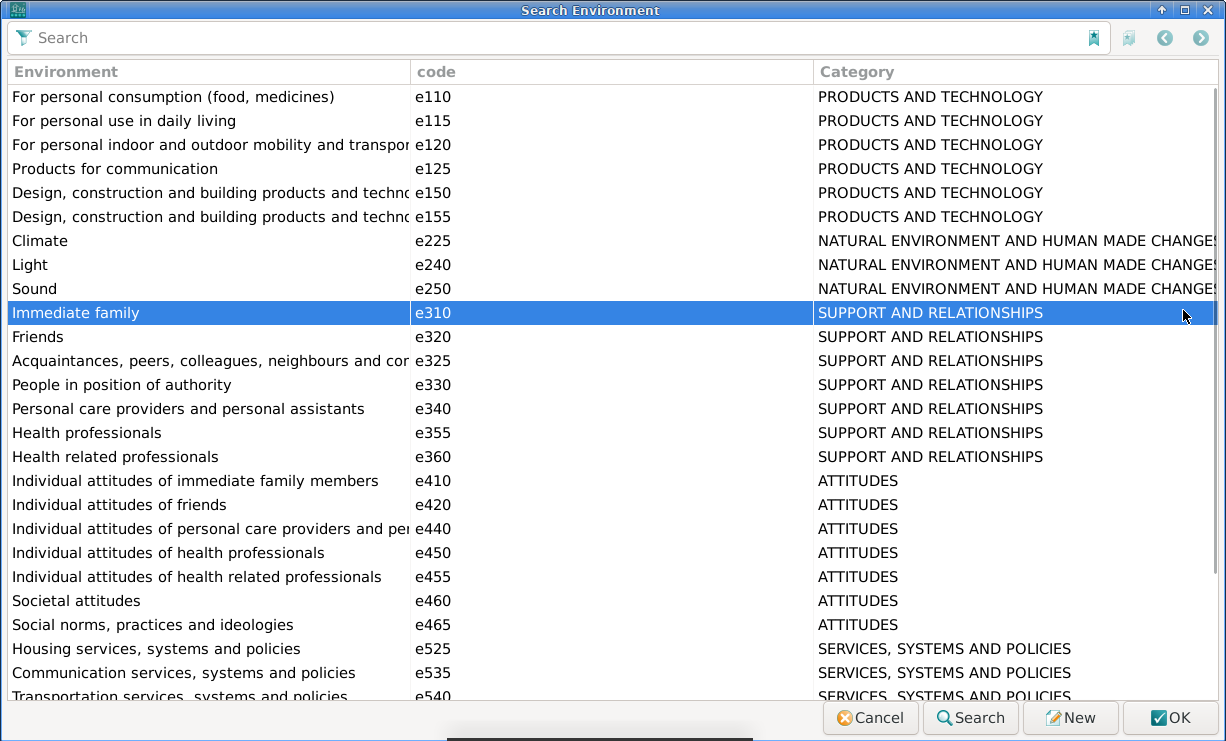
A key aspect on ICF is assessing the personal and environmental factors (exposome) in the context of a person’s health condition.
This includes not only physical or architecture/ urbanistic barriers, but also socioeconomic determinants and the degree of help a person get from family and friends.
The environmental and personal factors should have the same weight as the biological factors in assessing ICF.
Activity, participation, capacity and performance
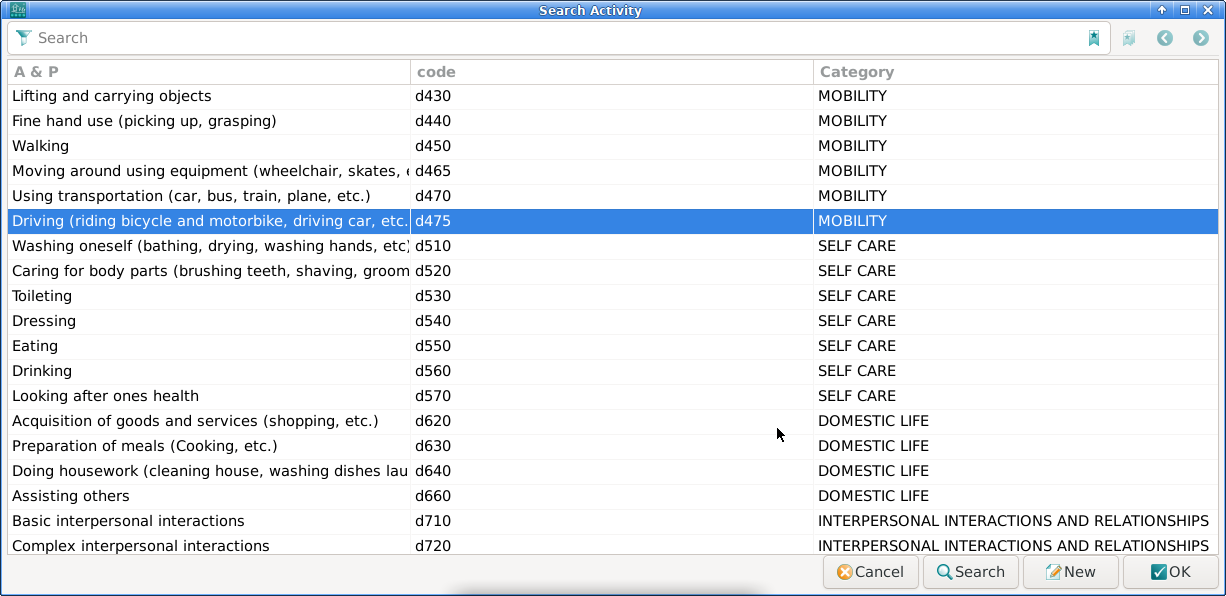
In GNU Health we can also record the degree of a person to do daily life tasks in the context of a health condition. For each domain / category we can find barriers, but also facilitator to improve the capacity and performance in doing such tasks.
GNU Health additional and complementary information
In the context of a person functioning and disability assessment, GNU Health incorporates some extra information that complements ICF. For example, the UXO (Unexploded Ordnance) or amputation status and etiology.
In addition to this, the demographic, socioeconomic and lifestyle functionality and information (provided in their respective packages) complements very well the functioning and disability, particularly for the Personal and Environmental components. It is highly recommended that these GNU Health packages are installed.